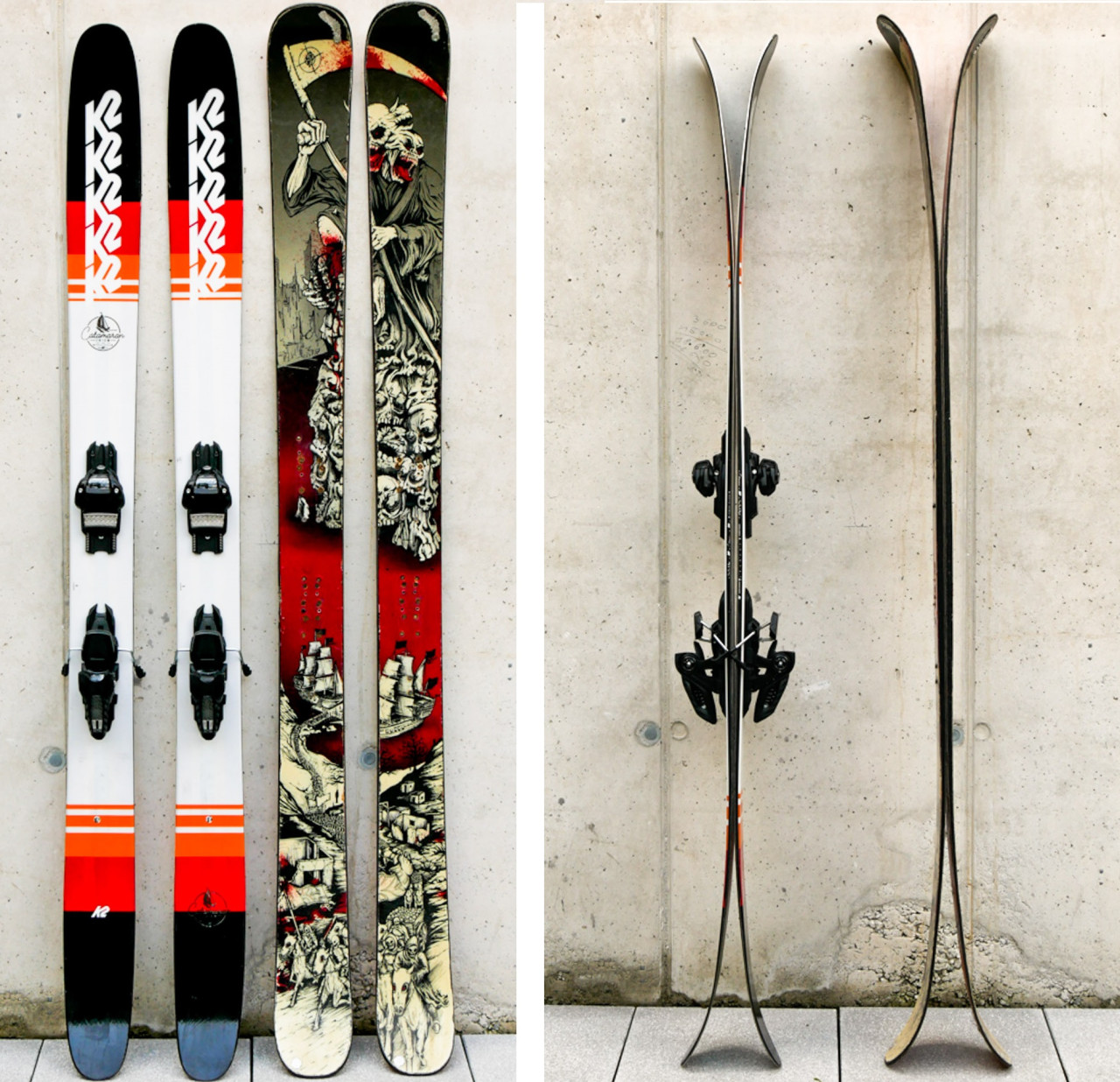
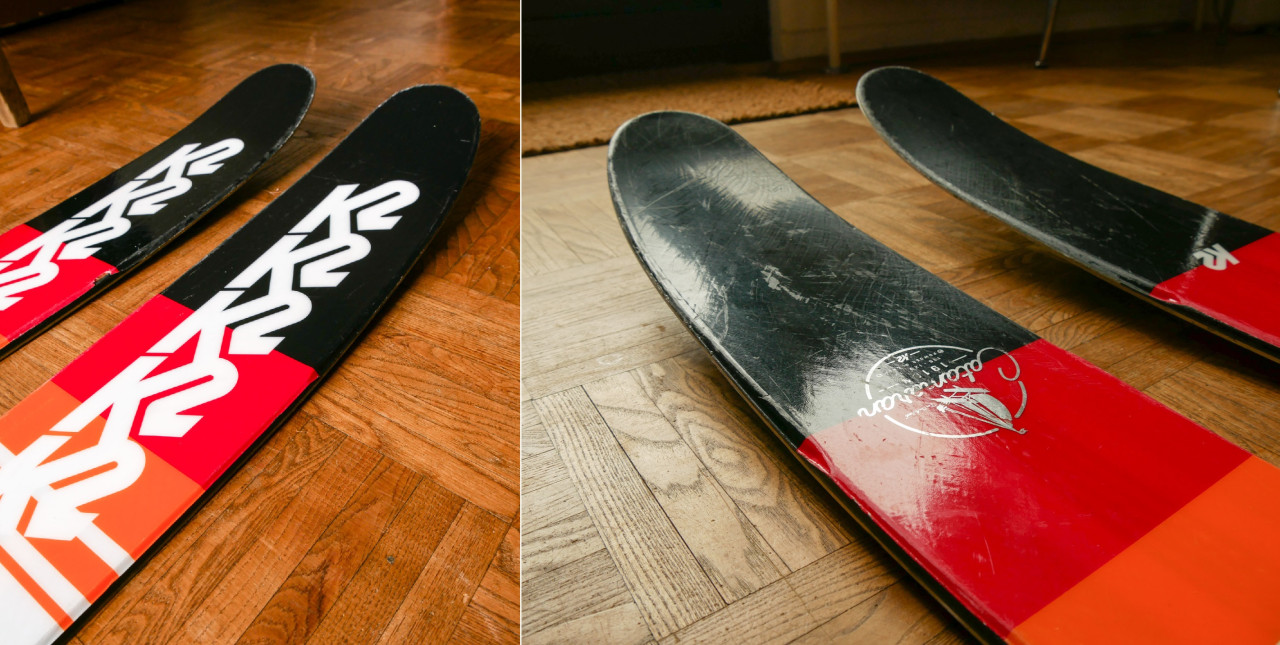
If you flex the Catamaran by hand, it doesn't seem particularly soft. Here, however, it bends mainly at the softer ends of the tip and tail. The ski (in the 191 length) rides much harder and seems more stable than its predecessors. This made for surprised faces, both for me and for some of the K2 team riders. I actually like softer skis, preferably with a symmetrical flex that progressively softens towards the tips. This type of ski with an almost centrally mounted binding is my favorite. The Catamaran is similar, except that it is not a noodle and is definitely harder under the binding than some of its predecessors. The ski design is based on the flex of the ski, so the white area indicates the rather hard part, while the color gradations towards the tips could stand for the progressively softer flex.
The ski feels light and looks cleanly finished. It looks solid, as is typical for K2, but has a semi-camp construction in the tip and tail area. This somewhat delicate-looking construction shows no flaws, even after prolonged testing. In addition, K2 uses two different hard and heavy woods for the core, which offers a slight weight saving while maintaining good torsional rigidity and good edge grip.
For me personally, the length and the center width of the ski are ideal for all-round use. As I've only skied on wider, even longer or narrower, shorter skis in recent years, I was really looking forward to a ski with this center width and length and of course I wanted to see how the successor to my beloved Hellbent would ski!
Test
Luckily, there was still some fresh snow last late winter towards the end of April/beginning of May, so I was able to use the ski for over 10 days in powder and spring powder. Then there's slush, normal snow and a bit of icy artificial snow slopes this fall. There are two reasons for using the Catamaran for the start of the artificial ice season on the glacier: Firstly, it still has the sharpest edges of all my skis, and secondly, for a ski of this width, it skis really well on the hard piste and I really enjoy carving it. Thanks to the camber under the binding area, it has good grip and, depending on how much power you put into a carved turn, it can also be turned in different radii. The transition from camber to rocker is gradual, so that you can get a little more effective edge length if necessary and with enough effort. During the turn, you can choose whether to finish it over the tail or release the tail. The transition between carved, powerful turns and drifted, surfier turns is very fluid on this ski, so you have the right turn ready for every situation.
The ski has more early taper than its predecessors, and while on these skis the buttering, turning and smearing away over the tail was accessed more via the soft flex, the Catamaran does this less via the flex and more with the help of its maneuverability thanks to the early taper at the front and rear. The tips and tails are rather narrow and the Catamaran is not much wider than its little brother, the Marksman, so the ski "pokes through" everywhere, doesn't slow down and you don't get stuck anywhere when you turn. Thanks to the thinner shovels and the widest part of the ski, which is offset far towards the center of the ski, the Catamaran also tends to ski through the snow and only floats up more and more as speed increases. This is in contrast to the more typical Hellbent/Pettior float, which certainly has its advantages in some situations, but also has a braking function.