

Articles on the topic
Schneedecke
-
SnowFlurry
SnowFlurry 13 2016/17 | Snow profile review
01/27/2017 • Lukas Ruetz In order to counteract the "I-only-understand-the-station" mentality when viewing snow profiles - whether in a snowflurry or on various avalanche warning service portals - we turn back to explanatory examples. As an introductory explanation, we recommend How to read and interpret a snow profile.
-
SnowFlurry
SnowFlurry 11 2016/17 | Snow cover & tensions
01/13/2017 • Lukas Ruetz Some people may ask themselves: "Why wasn't it dangerous before the change in the weather in terms of the old snow problem? The weak layers were already pronounced before." The answer lies in the tension.
-
WeatherBlogs
SNOWGRID at PowderGuide
01/01/2017 • PowderGuide As of today, SNOWGRID maps from ZAMG for Austria and some neighboring parts of the Eastern Alps are available on PowderGuide. SNOWGRID is a high-resolution snowpack model that shows the spatial distribution of the snowpack in the terrain very well. We now have the current snow depth and the change in snow depth over the last 24 hours as a separate sub-category in the Weather/Snow section and are pleased to be able to offer this service together with ZAMG.
-
SnowFlurry
SnowFlurry 8 2016/17 | Measuring stations and other tools for tour planning
12/23/2016 • Lukas RuetzThere are many online aids for tour planning and risk assessment that go beyond the classic tools such as maps, guides, avalanche bulletins and conditions reports. They are particularly relevant at the start of the season or when half of your friends are already spending their free time at the outdoor pool and there is hardly any information available from the warning services. -
SnowFlurry
SnowFlurry 7 2016/17 | Repetition and clarification
12/15/2016 • Lukas Ruetz The Alpine region is still under the influence of an Omega high. The snow cover continues to build up at higher altitudes and on the shaded side, while there is something similar to firn on steep, lower southern slopes. Surface frost can also be found, but only rarely due to the low humidity in relation to the amount of radiant nights.
-
SnowFlurry
SnowFlurry 5 2016/17 | Fair weather phases and the snow cover
12/03/2016 • Lukas Ruetz Periods of fine weather with wintry temperatures trigger massive build-up transformation processes in early winter, or when the snow cover is not very thick. This is usually not a problem during the fine weather phase, but is definitely problematic when the weather changes.
-
SnowFlurry
SnowFlurry 4 2016/17 | The snow cover sandwich
11/24/2016 • Lukas Ruetz Depending on the area and altitude, there are already some melting crusts within the snow cover that have been created by rain events or warm air intrusions. Weak layers often develop around these. Why is this?
-
SnowFlurry
SnowFlurry 2 2016/17 | Substitution
11/11/2016 • Lukas Ruetz There are a lot of things in snow and avalanche science that can be classified as wrong or at least need to be put into perspective. Misunderstanding of complex contexts also plays a role in this respect. We clear up some of them and explain what you should memorize instead.
-
SnowFlurry
SnowFlurry 1 2016/17 | How will we browse in the future and what do avalanches have to do with autumn?
11/04/2016 • Lukas Ruetz There have already been five avalanche fatalities in (South) Tyrol this season. Unfortunately, because where there is snow and mountains, there are also avalanches - no matter what time of year.
-
mountain knowledge
Study | SLF - Winters are getting shorter
10/04/2016 • PowderGuide In a recently published study by the University of Neuchâtel and the SLF (WSL), snow depth data from 11 weather stations in the Swiss Alps were examined. The stations are located in an altitude range between 1139 and 2450 m and the time series go back to 1970. The duration of snow cover has decreased at all 11 stations, whereby the earlier melting of the snow cover in spring is reflected in the statistics.
-
WeatherBlogs
WeatherBlog 23-2016 | Greetings from the Sahara
04/05/2016 • Lea Hartl The last few days have been rather frustrating in terms of skiing in large parts of the Alps. T-shirt temperatures in the valleys and T-shirt removal temperatures at many climbing crags, rapidly dwindling snow and increasingly brownish remnants of pistes have reduced the motivation for ski touring. Why is it not really freezing at night, even though the weather is somehow "nice"? Is it going to get cold again and what's next?
-
mountain knowledge
Overview of snow cover tests
02/03/2016 • Lea Hartl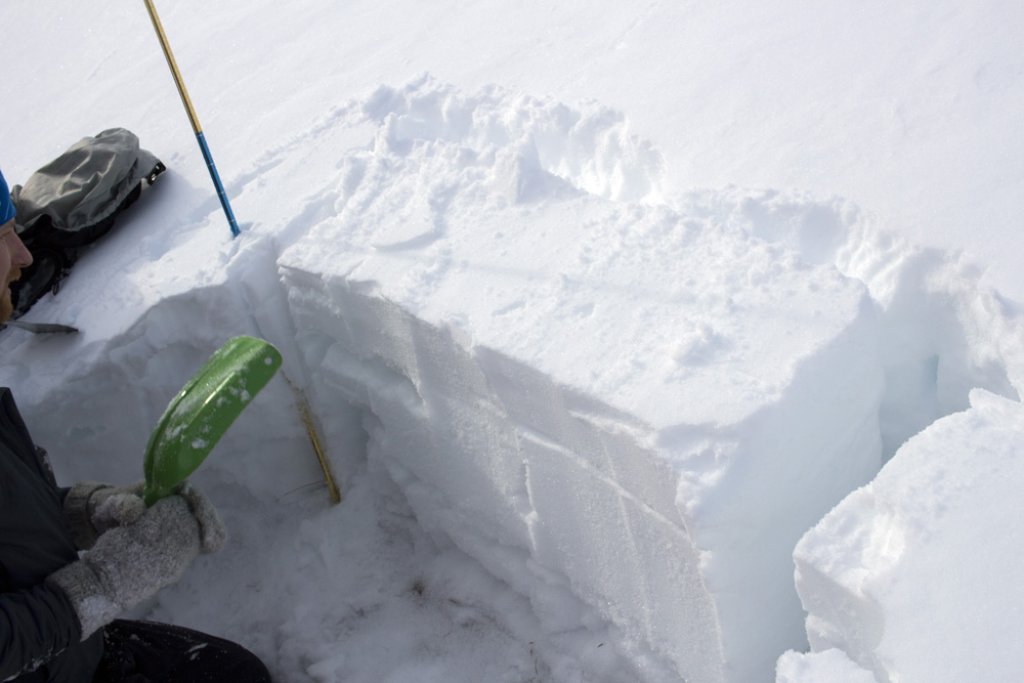 If you want to know something about the stability of the snow cover and would rather not test it by driving into it, you need alternatives. The basic principle of snow cover tests is similar to driving in: You hit it or otherwise provide a load and see what happens. Unlike driving in, you do this in a controlled environment so that you can actually have a look first and don't get buried straight away.
