

Articles on the topic
SLF
-
mountain knowledge
SLF: From 22/23 intermediate stages in the bulletin
11/28/2022 • Lea Hartl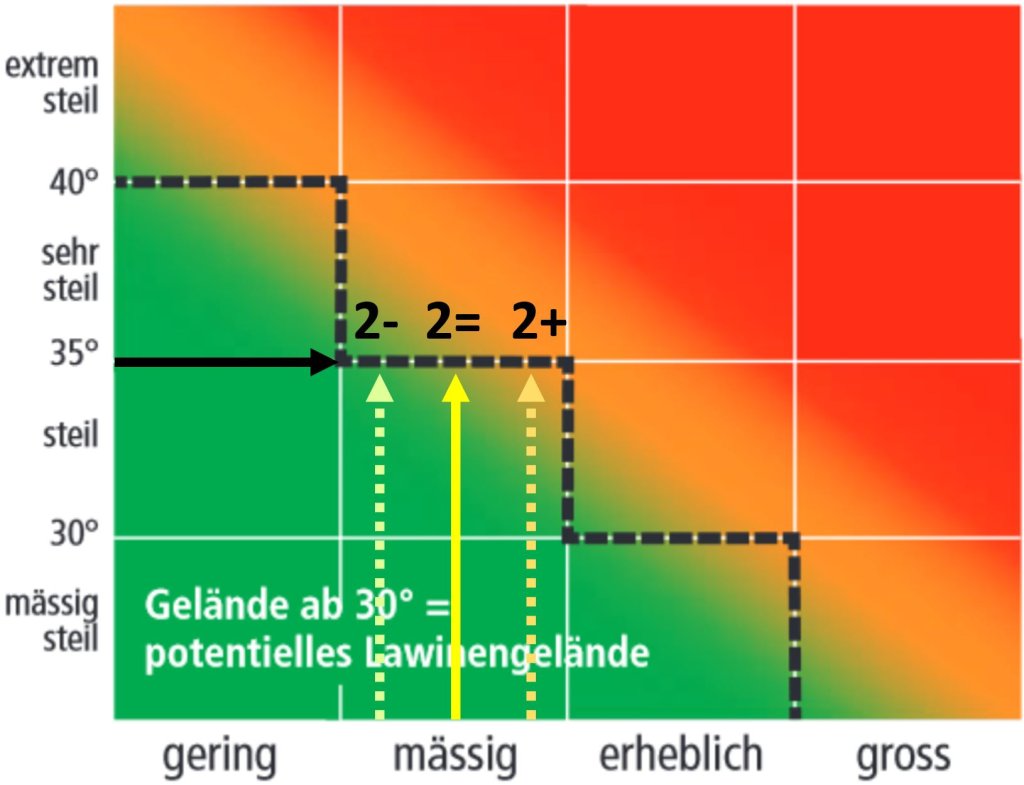 What experienced skiers could more or less reliably glean from the text of the bulletin is now put into concrete figures. From this season onwards, the SLF will use three intermediate levels for the avalanche danger levels moderate, considerable, large and very large. For level 3, for example, a 3, 3= or 3+ is given in addition to the "whole" level (3, considerable). 3- is closer to 2, 3= is "neutral" and 3+ is closer to 4.
-
news
First snowfall in the north
09/18/2022 • PowderGuide Long awaited and now finally here after a long, hot summer: the first snowflakes at below 2000m, sugared mountains, push messages from the avalanche warning services. Even with a lot of motivation, it's not quite enough for ski tours yet, but we're still happy about the first hint of winter mood.
-
mountain knowledge
Reading tip | SLF Winterflash
04/12/2022 • PowderGuide The skiing winter is not over yet, but it is slowly coming to an end. This can be recognized by the fact that the first reviews of the season are already available, for example from the SLF.
-
safety reports
Report | How do SLF observers work in the field?
04/05/2022 • Alexander Braschel The SLF observers monitor and assess the current situation in their area and transmit the observations to the SLF (WSL Institute for Snow and Avalanche Research SLF). The data collected forms part of the basis for the daily avalanche bulletin. I was allowed to accompany Reto, one of the observers, for a day and look over his shoulder.
-
news
Lecture tip | Johan Gaume at ÖGSL schnee.semmelnar
04/02/2022 • PowderGuideIn the monthly "schnee.semmelnar" of the Austrian Society for Snow and Avalanches (ÖGSL), avalanche researcher Johan Gaume will be appearing next Monday to explain (in English) what "supershear avalanches" are and what a better understanding of the trigger mechanisms means for risk management. -
mountain knowledge
World of Science | Avalanches and artificial intelligence
03/28/2022 • Lea Hartl Artificial intelligence and machine learning are the buzzwords of the moment in many areas and have been for the last few years. Corresponding techniques are also increasingly being used in snow and avalanche research. What exactly is AI, what are its concrete applications and what are the benefits?
-
WeatherBlogs
WeatherBlog 18 2021/22 | Boredom
03/23/2022 • Lea Hartl If it were in any way promising, the WeatherBlog would go on strike. But unfortunately, as we all know, you can't negotiate with the weather and so we remain trapped in the dry boredom of the concrete high, which is slowly but surely becoming a depressing monotony. On the crystal ball horizon there are signs, albeit still uncertain, of a late frost.
-
mountain knowledge
Lecture tip | SLF avalanche warnings on the subject of old snow
03/15/2022 • PowderGuideIn a new format called "AvaLounge", the SLF provides insights into the snow cover of the current winter. In a free online lecture, the avalanche forecasters discuss the topic of old snow in particular. -
videos of the week
Videos of the Week #12 2021/22 | The science of snow and avalanches
02/18/2022 • Sebastian MüllerYou can describe snow and avalanches using physics. In order to understand a snowpack, thermodynamics is required above all, which describes the partial pressures and transformation processes of the crystals. The triggering of an avalanche requires a description of the mechanical properties of the snowpack and fluid dynamics are used for its propagation. However, science can sometimes be quite dry. That's why today we are presenting videos that make the subject matter more digestible. -
PowderAlerts
PowderAlert 8 2021/22 | Back to the past!
01/08/2022 • Lars OelmannUllr says: McFly, anyone home? And he's not sending us back to the future, but back to the past, because now we're finally arriving where we were in mid-December: Winter. -
mountain knowledge
World of Science | New perspectives on the reduction method and co
01/06/2022 • Lea Hartl A recent SLF study uses GPS tracks from the Skitourenguru.ch database to correlate avalanche accidents with the number of accident-free ascents. This makes it possible to calculate which danger levels and terrain characteristics are particularly risky. There are some interesting differences to the reduction factors known from the Munter reduction method.
-
snow of tomorrow
Snow of Tomorrow | The art of making snow
12/06/2021 • Lisa Amenda Piste guns or snow farming sites - all there to herald the start of the winter season as early as possible. But what is behind these two methods and do we really need them?


