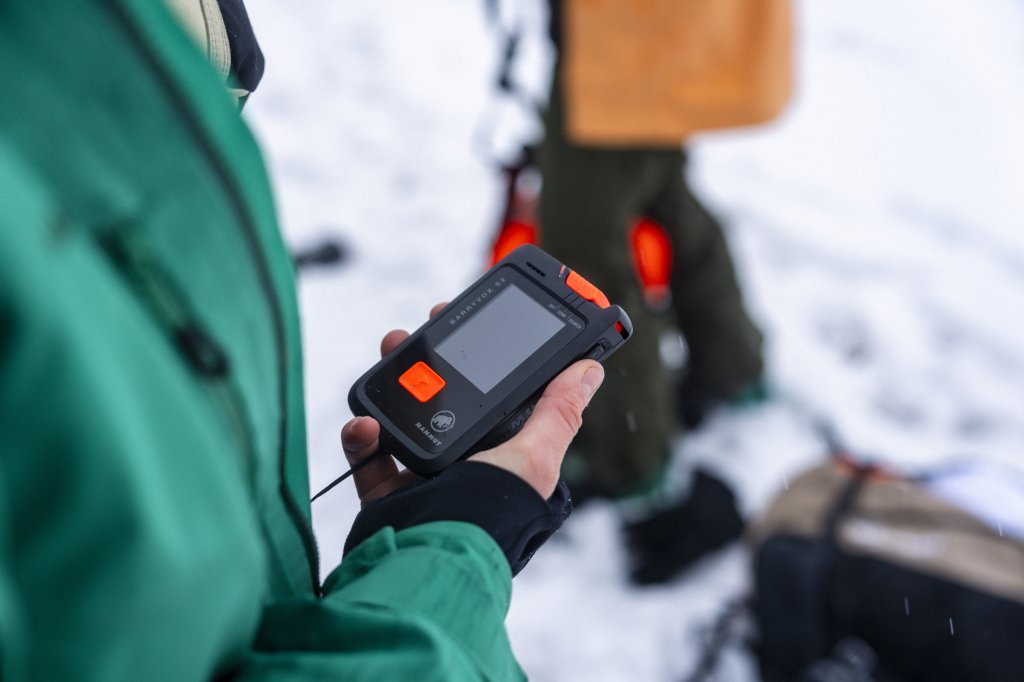
The new Barryvox S2
The first thing you notice about the new Barryvox S2 is its compact shape. It is not tiny, but it is noticeably smaller than the previous model and of course a few grams lighter - also because instead of the 3 AAA batteries previously used, only 2 AAA batteries are now used, although these can still power the device for longer. The large display also catches the eye; thanks to the Memory in Pixel technology, it should be very easy to read even in direct sunlight. Another interesting feature is the interference guard, which issues a warning in search mode in the event of interference and recommends reducing the search strip width or increasing the transmission power in transmit mode.
Also worth mentioning is the new Barryvox app, which not only allows you to make settings on the avalanche transceiver via Bluetooth, but also to install the latest firmware or use the training functions.
The three-antenna design, the recommended search strip width of 70 metres and the guided fine search have been retained. The simple design with just the main switch at the top, the marker button and the rocker button on the side is also comparable with the Barryvox S.
In theory, the Barryvox S2 would also have the option, similar to the Diract Voice from Ortovox, to give voice instructions during the search, but this function is currently deactivated due to patent disputes in Germany, Austria, Switzerland and the USA.
In addition to the new S2, there is also a "basic" device, the Barryvox 2, which offers the same hardware but has fewer additional functions and is slightly cheaper.
Testers and test conditions
I do a lot of ski touring and much less freeriding in the ski resort. In any case, I often have an avalanche transceiver with me and also practise with it (more or less) regularly. I have already tested several avalanche transceivers, for example the Barryvox S about 7 years ago.
The Barryvox S2 was tested during the current season and has been used on a few ski tours in the meantime. Fortunately not in an emergency, so the search function was only used and tested during exercises.