Skip to content

Cookies 🍪

This site uses cookies that need consent.

Learn more

Zur Powderguide-Startseite Zur Powderguide-Startseite
equipment

Ski Workshop | Binding adjustment - Touring bindings

How do I adjust my touring binding correctly?

03/06/2025
Fritz Crone
Many ski tourers still leave the fitting and adjustment of bindings to the specialists, although at least the adjustment of bindings is not particularly complicated. But are you actually allowed to adjust bindings yourself? Legally, this is a grey area. In theory, insurance companies can demand proof of binding adjustment by a specialist in the event of a claim, but in practice this happens extremely rarely. Adjusting your own bindings helps you to better understand your own equipment and to be able to help yourself in the case of a problem in the terrain. So it's worth trying at least once. And in case of doubt? You can always ask a specialist for help.

Touring bindings

In general, touring bindings can be divided into three types:

  • Frame bindings (e.g. Marker Tour F, Fritschi Diamir Scout)

  • Hybrid bindings (e.g. Atomic/Salomon/Armada Shift, Marker Duke Pt)

  • Pin bindings (e.g. Marker Alpinist, Dynafit Rotation, ATK Raider)

Frames and hybrid bindings can generally be adjusted in the same way as normal alpine bindings (see article). As pin bindings work differently, they also need to be adjusted differently. Pin bindings offer the great advantage over frame and hybrid bindings that they can be built particularly light due to their design. The disadvantages are power transmission and the riding experience, but above all safety. In general, high elasticity and strong restoring forces prevent false releases. Pin bindings usually have less elasticity than alpine bindings and are therefore known to be more prone to false releases.

Classification of touring bindings

There is a wide variety of bindings on the market with different elasticity and release mechanisms, and almost every manufacturer offers models with different characteristics in terms of these. Touring bindings can be easily sorted according to weight, as it goes without saying that lightweight bindings need to be lighter.

The following table is an attempt to categorise touring bindings. The table is sorted by weight and divided into front and rear jaws and the resulting elasticity and adjustment options are shown.

Light Toe Pieces

Weight-optimized toe pieces

Light Heel Pieces

Heel pieces without length compensation, Z-value predetermined by U-spring and only adjustable by replacing the spring, binding is mounted to sole length and can then no longer be adjusted. Examples:

-          ATK Revolution World Cup (105g)

-          Dynafit Low Tech Race 105 (108g)

Medium-weight Toe Pieces

Weight-optimized toe pieces with entry aid

Medium-weight Hell Piece

Heel pieces with length compensation, adjustable Z-value, (removable) ski brake, heel adjustment travel.

Examples:

-          ATK Raider Evo 11 (370g)

-          Dynafit Blacklight+ (370g)

-          Marker Alpinist Free 13 (395g)

-          Fritschi Xenic (280g)

Heavy Toe Pieces

djustable Z-value, entry aids, anti-icing protection, elasticity

Examples:

-          Fritschi Vipec Evo

-          Tecton

-          Rotational toe pieces (Dynafit Rotation)

Heavy Heel Pieces

Heel Pieces with length compensation, adjustable Z-value, ski brake, heel adjustment, alpine heel pieces (Fritschi Tecton, Marker Kingpin)

Examples:

-          ATK Freeraider 15 Evo (395g)

-          Dynafit ST Rotation (605g)

-          Marker Kingpin (715g)

-          Fritschi Tecton (650g)

The categorisation is an attempt to show that the adjustment options for pin bindings depend heavily on the weight of the respective binding. Not all bindings can really be categorised, the wide product range of Dynafit and ATK, for example, offers many models in between. There are super-light bindings that still allow the Z-value to be adjusted (e.g.: Dynafit Mezzalama, Dynafit Superlite 150) or super-light bindings that allow a large heel adjustment range (e.g.: ATK Trofeo Plus). Bindings can also be "pimped up" with various accessories. Adjustment plates then offer a large heel adjustment range despite ultra-light heel pieces, "freeride spacers" are intended to improve power transmission and shims improve overall performance.

Now it is important to correctly adjust the bindings you have on your skis, but it is also important to differentiate between the various bindings.

Adjusting the sole length

In order to set the sole length correctly, the type of binding must be taken into account, whereby the sole length is set exclusively via the heel piece. Pin bindings with an adjustable heel length can be divided into 3 categories:

  1. Heel length adjustable on the adjustment plate: Adjustment plates are mounted on the ski with the binding. They have a significantly longer hole pattern, between which you can then adjust your rear jaw to the available clearance. Using the appropriate screwdriver, loosen all the screws that fix the rear jaw to the plate. When adjusting the sole length, the distance between the boot and the heel piece must be taken into account. Manufacturers supply a spacer for this purpose, which can be used to set the ideal distance. The spacer must be placed between the heel piece and the heel of the ski boot. If the distance is correct, I can tighten the screws again (it is best to tighten them diagonally and then check again that the distance is correct). Example photo: Adjustment plate for Dynafit Superlite 150)

  2. Heel length adjustable on the heel piece: The heel piece can be adjusted via a long thread, the screw for this is usually located at the very end of the heel piece close to the topsheet of the ski. The distance between the boot and the heel piece must be correct, which is why the manufacturer supplies a spacer that is placed between the rear jaw and the heel of the ski boot. The heel piece should then be screwed forward until the distance is correct.

  3. The third variant allows the contact pressure on the heel piece to be adjusted; this only applies to bindings with a (weight-reduced) alpine heel piece. The heel piece can be moved forwards and backwards using a screw, the correct contact pressure is set using the indicator (King Pin: screw is on the same level as the housing, Tecton: similar to Fritschi pin rear jaws, a gap of 1 mm must be set. Here is a video as an explanation.

Setting the binding

Once the sole length has been set correctly, we turn our attention to adjusting the bindings. As mentioned above, these are categorised and treated as light, medium and heavy toe and heel bindings.

Toe Piece

Heel Piece

Light

As a rule, the lightest toe pieces do not offer any adjustment options

The lightest heel pieces generally offer hardly any adjustment options. However, the U-spring can be changed on most models and as these are available in different strengths, you can theoretically adjust the Z-value to your skiing ability and weight. U-springs are available, for example, from binding manufacturers for spare parts. However, the U-spring only determines the vertical release, not the lateral release.

Medium-weight

ATK offers the option of adjusting the Z-value on the Raider Evo, and this is also possible on other ATK models. This is not possible with other manufacturers in the “medium-heavy toe” range.

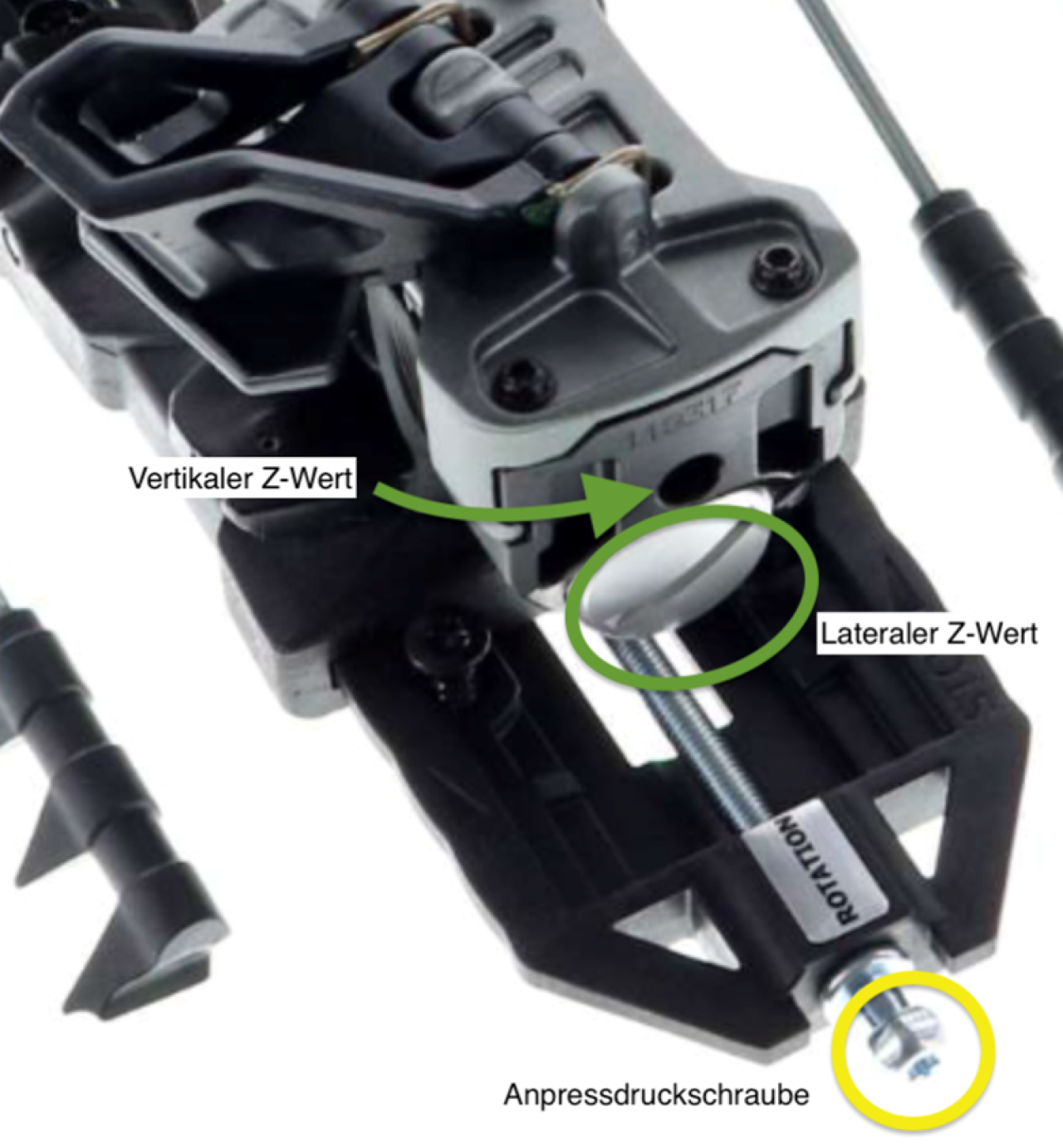
This category already offers a wide range of adjustment options. The lateral Z-value can usually be adjusted using a screw (e.g. Marker Alpinist, Dynafit Blacklight+) and the vertical Z-value can also be adjusted on some bindings (e.g. ATK Raider Evo, Fritschi Xenic). The heel adjustment range is usually standard here, which means you can use your pin binding with different boots as long as the sole lengths are within the adjustment range.

Heavy

With heavier toe pieces such as the Fritschi Vipec Evo/Tecton, the Z-value can be adjusted; the Vipec Evo/Tecton toe pieces also offer elasticity, which should ensure reliable release. The toe piece of the Dynafit ST Rotation does not offer an adjustable Z-value, but it can move a few degrees in downhill mode and thus enables more reliable lateral elasticity in the heel pieces.

The heavy heel pieces are mostly similar to those of normal alpine bindings, but with a slightly reduced weight. As with their heavier relatives, the Z-value can be set and, which is not possible for pin binding heel pieces, a contact pressure.

When talking about the topic of toe pieces in pin bindings, it is of course also important to talk about the generally controversial topic of "locking the toe pieces when skiing down" .

Locking Yes or No?

Unlike alpine bindings, pin bindings can be locked. This function is essential for ascending, but there are also situations during the descent where it makes sense to lock the pin binding. If you lock your binding, you prevent the lateral release of the binding in the event of a fall and therefore risk a higher risk of injury. Locking the binding should therefore be carefully considered! In my opinion, there are few situations in which locking the binding actually makes sense. I would like to briefly explain a few that come to mind.

Danger of slipping: There is a risk of slipping if the slope gradient and snow conditions make it impossible to slow down independently without skis. By locking the binding, the loss of skis can be avoided and slipping can be stopped more quickly. Even if there is a risk of slipping, you should not carelessly lock your bindings, but only if slipping would have serious consequences (e.g. if the slope becomes so steep that you would fall extremely quickly).

Risk of falling: When there is a risk of falling, there is often also a risk of slipping, which is accompanied by exposure. So if a slip would inevitably mean a fall with serious consequences (serious bone fractures or even death), locking the binding is an option in order to better slow down the uncontrolled slide. A false release can also lead to uncontrolled slipping in exposed terrain, so if losing a ski would increase the consequences in the event of a fall, it may be worth locking the binding.

However, in my opinion, locking the binding also has many disadvantages that should be taken into consideration. In addition to the obvious disadvantages (increased risk of injury, for example), the inserts in the boot wear out more quickly in locked mode on the descent, especially when jumping or skiing on very hard icy snow. Another disadvantage is that the skis that do not come off act as an anchor in an avalanche and could increase the burial depth. Personally, I very rarely find locking the toe piece useful.

Now that we have looked at the settings and the advantages and disadvantages of different pin bindings, let's look at a few more details.

Ski brake yes or no?

To really save every last gram of weight, the ski brake can be omitted from some pin bindings. The advantage comes solely from the weight reduction, but there are some minor disadvantages: When shouldering skis, you have to hold the skis together or tie them together with a ski strap. In the event of a fall, the ski can travel very long distances before it comes to a halt. It is also more difficult to get into the skis because the ski moves more with and under the boot without a stopper. Alternatively, there are catch straps, which many have long since abandoned, although some well-known skiers (e.g. Vivian Bruchez) can still be seen using them. Safety straps weigh a similar amount to lightweight ski brakes, but have the advantage that the ski remains securely in the vicinity in the event of a release. Unfortunately, this is also the major disadvantage of this variant, as the skis themselves become a danger due to their edges, for example. In addition, the skis can become an anchor in avalanches and pose an additional risk.

Hybrid binding or pin binding

Last but not least, I would like to give my opinion on the range of use of the various touring and hybrid bindings.

The range of touring bindings is wide and almost every manufacturer now has pin bindings in their range that focus on downhill characteristics. Classic examples are the ATK Freeraider, Marker King-Pin and Fritschi Tecton. For better power transmission, the King-Pin and Tecton work with weight-reduced alpine heel pieces and the Freeraider with the so-called Freeride Spacer. The Freeride Spacer prevents torsion of the ski boot in the two rear pins and (thus) creates a better connection and therefore better power transmission to the ski. The fact that pin bindings are becoming better and better for downhill skiing means that they are also being used more frequently by skiers in ski resorts. Clever marketing is also making young people think twice about whether pin bindings are enough for the ski resort when the pros use them to ski extreme lines with high drops. Perhaps there will be a more comprehensive article on this topic that is not just based on my own opinion. Nevertheless, I think that constant use in the ski resort puts much more strain on the material than would be possible just by touring, and this applies to both skis and bindings. Hybrid bindings such as the Salomon Shift are also built to reduce weight and, in my experience, are not as robust as pure alpine conditions. Ultimately, however, you want to find a compromise in order to be able to freeride in the ski resort and then go on a short tour afterwards. For aggressive freeriders who are also big and heavy and/or rough with their equipment, the choice of robust equipment is very small (e.g. Cast System with Look Pivot, Marker F12 Tour EPF, Marker Duke PT). For smaller, lighter or less aggressive freeriders who are good with their equipment, the Salomon/Atomic/Armada Shift is certainly a good choice. Good handling of binding material requires that the binding is perfectly adjusted and that you regularly check the settings yourself.

Photo gallery

Note

PowderGuide.com is nonprofit-making, so we are glad about any support. If you like to improve our DeepL translation backend, feel free to write an email to the editors with your suggestions for better understandings. Thanks a lot in advance!

Show original (German)

Related articles

Comments